


Transforming Meeting Management with Microsoft 365
- Sergii Dovgalenko

- May 22
- 3 min read
Updated: Jul 7
The Vicious Circle of Legacy Meeting Management
The problem is usually not the meeting itself. The real operational inefficiency starts after the meeting ends. Meeting management creates a surprisingly large amount of repetitive operational work:
Preparing agendas
Collecting discussion points
Writing meeting minutes
Distributing summaries
Tracking actions
Following up on deadlines
Maintaining records
Preparing reports
Searching for previous decisions and commitments
As meeting volumes increase, this administrative layer becomes increasingly fragmented across Outlook, Teams chats, spreadsheets, SharePoint folders, and personal notes. Eventually, operational coordination itself becomes difficult to manage consistently.
This becomes especially visible in procurement, supplier management, PMO, and operational coordination environments. Here, meetings directly drive sourcing activities, supplier follow-up, project execution, approvals, operational reporting, and cross-functional coordination.
The result is usually predictable:
Actions become difficult to track
Ownership becomes unclear
Follow-up becomes inconsistent
Reporting becomes manual
Operational visibility deteriorates
Meeting history becomes fragmented
Ironically, most organizations attempt to solve this problem by adding more meetings to ease the pain of unresolved actions.
The Way Out
Instead, I decided to automate the administrative layer around meetings using Microsoft 365 Power Apps, SharePoint, Teams, Azure Speech (text-to-speech), and AI-assisted transcript processing.
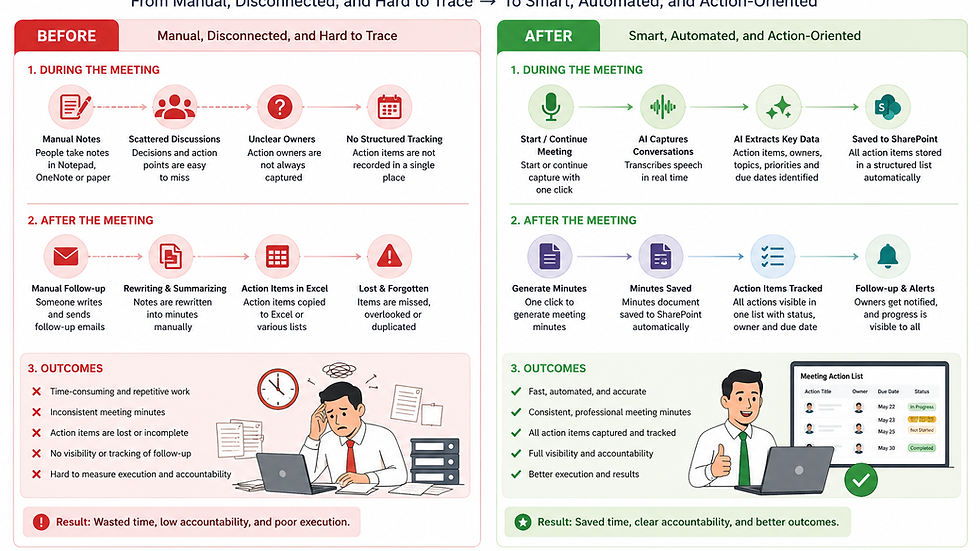
The objective was not to create another “AI meeting assistant" but to simplify operations using tools most organizations already own within Microsoft 365.
The solution automates several repetitive operational activities around meetings:
Transcript intake
AI-assisted meeting summaries
Action item extraction
Owner identification
Operational highlights
Meeting minutes preparation
Centralized storage (audit trail)
Follow-up tracking
The workflow uses Power Apps recordings and resulting transcript files as operational inputs. Power Automate processes the transcript, applies AI where useful, generates structured outputs, and stores the information centrally in SharePoint.
Importantly, AI is not replacing operational control or human review. We still retain a human-in-the-loop when a secretary checks AI-generated actions. AI reduces repetitive administrative processing where manual effort adds little operational value.
This distinction matters because most organizations do not need fully autonomous AI meeting systems. They need practical operational support that improves coordination, visibility, documentation, and follow-up management without creating additional governance complexity.
The Cost and Benefit Analysis of Meeting Management
You can find more details in the YouTube video below. The interesting observation is that for such topical nano-solutions, the cost is accessible if not marginal:
Power Apps and Power Automate Premium - $35/month, inclusive of 5500 AI Builder credits (only 15-20 credits required for a 10-line agenda meeting)
Azure text-to-speech - $1/audio hour and free for the first year
CloudConnect WEBM-to-WAV audio conversion - $10/500 conversions, plus 10 daily conversions for free.

This is precisely where Microsoft 365 workflow automation becomes highly effective. Most organizations already possess the core ecosystem required to implement this approach: Teams, SharePoint, Outlook, Power Automate, and Power Apps. The remaining cost isn't material and is likely to be affordable even for the most cost-conscious SMEs, given the benefits.
This opportunity is not another platform purchase. The opportunity is operational integration and administrative simplification.
Embracing Automation for Better Outcomes
The future of meeting management is here. Embracing automation can transform how we manage meetings. It’s about making our processes smarter, not harder. By leveraging Microsoft 365, we can streamline operations and enhance productivity.
Imagine a world where meeting notes are automatically generated, action items are tracked seamlessly, and follow-ups are a breeze. This is not just a dream; it’s achievable with the right tools.
Conclusion
In conclusion, integrating Microsoft 365 tools can revolutionize meeting management. It’s time to break free from the chains of manual processes. Let’s embrace automation and make our workflows efficient and effective.
The full solution overview is available here: https://www.goodspending.com/ai-enabled-meeting-administration


Comments