


Understanding Procurement Decision DNA: A Guide for Professionals

Updated: Aug 4
Two experienced procurement professionals can analyze the same sourcing case, review the same facts, and still recommend completely different solutions. Neither is necessarily wrong. That's because procurement is not driven by knowledge alone. It is driven by how people make decisions under uncertainty.
The Procurement Decision DNA assessment explores those decision patterns.
Different People Optimize for Different Outcomes
Employers typically look for professionalism, energy, and confidence in their new recruits. After more than twenty years in procurement, I have become less certain—not because I know less, but because experience has shown me how many valid ways there are to solve a single problem.
Good procurement decisions are rarely black and white. What worked perfectly for me in the Middle East may be the wrong approach in Western Europe. A sourcing strategy that succeeds in a private multinational could fail completely in a public-sector organization.
That's one reason I adopted the concept of ecological rationality. This means making sound decisions with limited information, time, and resources rather than searching for a theoretically perfect answer.
I developed Procurement Decision DNA with no major ambitions, while keeping all of the above in mind. Rather than seeking the "correct" answer, it aims to reveal the behavioral preferences that influence procurement judgment.
There Is No Perfect Procurement Professional
Procurement competence frameworks, e.g., CIPS Global Standard, usually explain what professionals should know or demonstrate. They tell far less about how professionals actually make decisions when priorities conflict.
I believe there are very few universally correct answers in procurement. Many decisions are entirely appropriate within a particular organization, leadership culture, or commercial environment.
Competence and behavioral preference are different concepts. Procurement Decision DNA attempts to measure the latter—not the former.
Why Procurement Teams Need Cognitive Diversity
Companies often talk about diversity in terms of nationality, gender, or age. Those perspectives matter, but procurement will also benefit from diversity of thinking.
A public procurement function may need professionals who instinctively protect governance. A fast-growing commercial business may benefit from people who continually seek new sources of value. A humanitarian organization responding to natural disasters may prioritize speed of response, adaptability, and collaboration above everything else.
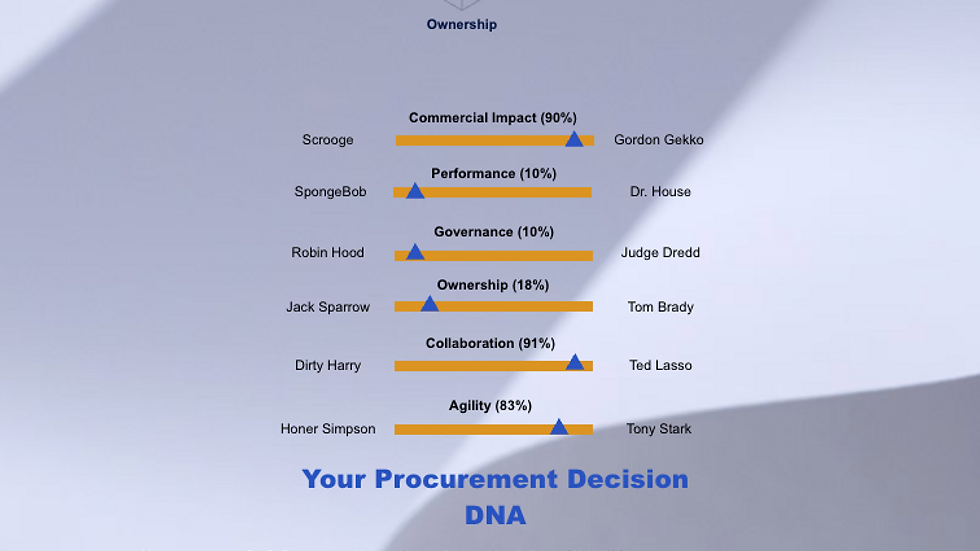
Perhaps Judge Dredd feels more comfortable in public procurement. Gordon Gekko may lead the commercial transformation. Ted Lasso would probably thrive in organizations where collaboration matters more than hierarchy.
I apologize for relying heavily on American fictional characters. I am, after all, what I watch.
Procurement Decision DNA Isn't a Personality Test
This assessment doesn't measure:
intelligence
procurement competence
procurement knowledge
CIPS or ISM proficiency
negotiation ability
leadership potential
It measures something much more specific—our decision preferences.
The fields of psychology and competency assessment are already occupied by excellent researchers and established methodologies. Rather than competing with them, I wanted to build something practical, procurement-specific, and, above all, non-judgmental.
How the Procurement Decision DNA Assessment Works
The assessment presents 40 realistic procurement situations. Each situation requires you to choose between competing but credible professional responses.
Your answers are mapped across six decision-making dimensions. The resulting one-page profile shows where your preferences sit on each spectrum and which recognizable professional characters best represent the opposing approaches.
The report is intended to support reflection and discussion. It can help:
Individual colleagues understand their natural decision preferences.
Procurement teams discuss differences without treating every disagreement as a competence issue.
Managers examine whether the team has sufficient cognitive diversity.
How Responses Become a Decision Profile
Procurement Decision DNA contains 40 questions, each with four credible responses. Every response contributes points to two of the six decision dimensions: one receives a primary weighting, and another receives a secondary weighting.
The six dimensions are divided into two groups:
Professional decision priorities
Commercial impact
Performance
Governance
Personal decision preferences
Ownership
Collaboration
Agility.
The assessment does not classify an answer as correct or incorrect. Instead, it identifies the professional priorities reflected in the selected response and combines those choices into an overall decision profile.
The final scores are calibrated separately for each dimension because the questions do not distribute scoring opportunities equally across all six dimensions. The percentages therefore represent a participant’s relative position on each decision spectrum; they are not examination marks and should not be added together.
What the Assessment Can—and Cannot—Claim
Procurement Decision DNA is a practitioner-designed professional reflection tool. It is not presented as a psychometrically validated personality, aptitude, or competence assessment.
Its purpose is to make procurement decision preferences visible and discussable. It may help individuals and teams examine why different experts approach the same commercial situation differently.
The results should therefore be interpreted as indicators of recurring preferences, not fixed personal characteristics or predictions of professional performance.
Frequently Asked Questions
What is Procurement Decision DNA?
Procurement Decision DNA is a 40-question assessment designed to identify how procurement professionals prefer to make decisions. It examines behavioral preferences rather than procurement knowledge, competence, or personality.
What does the assessment measure?
The assessment maps responses across six dimensions:
Commercial impact
Agility
Performance
Ownership
Governance
Collaboration
Each dimension represents a spectrum between two credible procurement approaches.
Is Procurement Decision DNA a personality test?
No. It does not attempt to measure personality, intelligence, leadership potential, or professional competence. It focuses specifically on preferences demonstrated when choosing between realistic procurement decisions.
Are there correct answers?
No single answer is treated as universally correct. Each question presents competing professional responses that may be appropriate in different organizational, commercial, or operational contexts.
Who is the assessment for?
It is intended for procurement professionals, procurement teams, managers, trainers, and students who want to explore how decision preferences influence sourcing judgments and raise professional disagreements.
How can procurement teams use the results?
Teams can use the results to discuss differences in decision-making, identify areas of cognitive diversity, and examine whether certain approaches are overrepresented or missing within the function.
Does the assessment evaluate procurement competence?
No. It does not assess technical knowledge, CIPS or ISM proficiency, negotiation capability, or procurement experience.
How long does the assessment take?
5-7 minutes, depending on the depth of question analysis you wish to undertake.
An Example of the Decision Logic
Consider the question which matters to any procurement professional:
When should procurement become involved?
Possible responses include:
when the business is ready to buy and has an approved budget;
when the business has decided what it wants to buy;
when the business is defining its demand;
when the business is deciding what problem it is trying to solve.
None of these responses is automatically wrong.
Joining when the budget and requirement are approved may reflect a stronger focus on delivery discipline and governance.
Becoming involved while demand is being defined may indicate a preference for commercial influence and stakeholder collaboration.
Entering before the requirement itself exists may reflect greater agility and ownership.
The assessment records these competing priorities across all 40 situations. The resulting profile therefore reflects repeated decision patterns rather than relying on a single answer.
Discover Your Procurement Decision DNA
Procurement Decision DNA doesn't tell you whether your decisions are right or wrong. It helps explain why you make them—and why equally capable professionals often reach different conclusions.
Understanding those differences is the first step towards building stronger procurement teams.


Comments